As an Amazon Associate this site earns from qualifying purchases.
Comparison table
| Product | BTU | Room size | Noise | Remote | Price |
|---|---|---|---|---|---|
| Frigidaire 6,000 BTU Window Air Conditioner | 6,000 | 250 sq. ft. | 52 dBA | Yes | Check price on Amazon |
| Midea 12,000 BTU U Shaped Window Air Conditioner | 12,000 | 550 sq. ft. | As low as 32 dBA | Wi-Fi + voice control | Check price on Amazon |
| Frigidaire 8,000 BTU Window Air Conditioner | 8,000 | 350 sq. ft. | 54 dBA | Yes | Check price on Amazon |
| GE Window Air Conditioner 5,000 BTU | 5,000 | 150 sq. ft. | 52 dBA low / 56 dBA high | No — mechanical dials | Check price on Amazon |
| Frigidaire 5,000 BTU Window-Mounted Air Conditioner | 5,000 | 150 sq. ft. | 52 dBA | Not stated | Check price on Amazon |
| 6000 BTU Window Air Conditioner w/Remote Control (GarveeHome) | 6,000 | 250 sq. ft. | Not stated | Yes | Check price on Amazon |
Quick answer: For most people, the Frigidaire 6,000 BTU Window Air Conditioner with Remote Control, Cools Up to 250 Sq. Ft., Quiet Operation, Eco Mode, 3 Fan Speeds, Auto Restart, White hits the sweet spot — a 250 sq. ft. rating, a remote, Eco and Sleep modes, and a price under $180. If you want the quietest and most efficient option and can spend three times as much, the Midea U-shaped inverter unit is in a different class. If you just need a small bedroom cooled cheaply, a 5,000 BTU unit will do it for around $160.
Window ACs haven't changed dramatically in decades, which is good news: the basic ones are cheap, reliable, and easy to install yourself. The real decisions are how many BTUs you need, whether you want a remote and digital controls, and whether noise bothers you enough to pay for an inverter compressor.
Frigidaire 6,000 BTU Window Air Conditioner — Best Overall
The Frigidaire 6,000 BTU Window Air Conditioner with Remote Control, Cools Up to 250 Sq. Ft., Quiet Operation, Eco Mode, 3 Fan Speeds, Auto Restart, White is the one I'd point most people toward first, because it's the cheapest unit here that doesn't make you compromise on the features you'll actually touch every day.
The best best window air conditioners for your situation depends on how you plan to use it and where.
It's rated for rooms up to 250 sq. ft. and runs at 52 dBA, which Frigidaire positions as bedroom-appropriate. You get three fan speeds, 6-way directional airflow, and a remote — that last one matters more than it sounds when the unit is mounted across the room behind a bed. Eco Mode is there to cut energy use while holding a comfortable temperature, and Sleep Mode gradually raises the setpoint overnight so you're not shivering at 4 a.m. and paying for the privilege.
Two practical touches: a 24-hour on/off timer, so you can have the room cool before you get home, and Clean Filter alerts that tell you when the washable dust filter needs attention. Dry Mode pulls moisture out of the air without full cooling, which is useful in humid shoulder-season weather. Auto Restart brings back your previous settings after a power outage.
At $176.99, it costs about $14 more than the barebones 5,000 BTU Frigidaire and adds a remote, a third fan speed, an extra 100 sq. ft. of coverage, timer, Eco, Sleep and Dry modes. That's an easy upgrade to justify.
Midea 12,000 BTU U Shaped Window Air Conditioner — Best for quiet, efficiency and large rooms
The Midea 12,000 BTU U Shaped Window Air Conditioner, Cools up to 550 Sq Ft is the outlier on this list, and it earns it. The U-shaped body straddles the window sash so the glass itself sits between you and the compressor, blocking noise outside. Combined with the DC inverter system, Midea rates it as low as 32 dBA and calls it 9x quieter than traditional units. For context, every other AC here sits at 52–56 dBA.
The inverter is also where the efficiency comes from: Midea claims over 37% energy savings versus traditional units, and says this was the first window AC to earn ENERGY STAR certification. If you run an AC hard for four months a year, that gap starts to close the price difference — though at $479.99 versus $208.99 for the 8,000 BTU Frigidaire, don't expect it to close fully.
The U-shape has a second benefit that's easy to overlook: your window still opens with the unit installed, so you can let fresh air in and keep more of your view. When the window is closed, an anti-theft mechanism locks it. It's Wi-Fi enabled with the SmartHome app on iOS and Android, plus Alexa and Google Assistant voice control.
Installation uses a quick-snap bracket: mount the bracket, set the AC on it, secure the sidearms. It fits single- or double-hung windows 22"–36" wide with a minimum height of 13.75". At 12,000 BTU it's rated for up to 550 sq. ft., so this is the pick for a large bedroom, an open living area, or a studio apartment where one unit does everything.
Frigidaire 8,000 BTU Window Air Conditioner — Best for medium living rooms
The Frigidaire 8,000 BTU Window Air Conditioner with Remote Control, Cools Up to 350 Sq. Ft., Quiet Operation, Eco Mode, 3 Fan Speeds, Auto Restart, White is the same design language as the 6,000 BTU model, scaled up for 350 sq. ft. rooms.
Feature-for-feature it matches its smaller sibling: remote control, three fan speeds, 6-way directional airflow, Eco Mode, Sleep Mode, Dry Mode, a 24-hour timer, Clean Filter alerts, washable dust filter, and Auto Restart. The one spec that shifts is noise — 54 dBA here versus 52 dBA on the 6,000 BTU unit. That's a small, expected penalty for the larger compressor and fan.
At $208.99 it's $32 more than the 6,000 BTU version for 100 extra square feet of rated coverage. If your room is genuinely in the 250–350 sq. ft. range, buy this one rather than hoping the smaller unit stretches. An undersized AC runs continuously, never reaches setpoint, and dehumidifies poorly.
GE Window Air Conditioner 5,000 BTU — Best for simple mechanical controls
The GE Window Air Conditioner 5,000 BTU AC Unit for Small Rooms up to 150 sq ft with Manual Controls & 2 Cooling Modes for Bedroom or Living Room, Easy Install Kit, White is deliberately old-fashioned, and for some buyers that's the entire appeal.
Controls are mechanical dials — temperature and fan speed, no Wi-Fi, no app, no setup, and as GE puts it, no annoying digital beeps. There are 10 temperature settings, two fan speeds, and two cooling modes: low at 52 dBA for nighttime, high at 56 dBA when you need the room cold fast. It's rated for up to 150 sq. ft., which covers bedrooms, home offices, dorm rooms, workshops and studio apartments.
It's also the most compact unit here at 16.4" W x 13.4" D x 12.6" H. Power draw is 440W, which GE frames as a saving against older, inefficient units. There's no manual draining under normal conditions and the filter is washable and reusable. The fixed chassis fits double-hung windows 27.125"–36" wide with a 13.375" minimum height, and the EZ Mount kit with foam insulation is included. GE backs it with a 1-year limited warranty.
At $159.00 it's the cheapest name-brand unit on this list. Good choice for a rental, a guest room, or anyone buying for a household member who doesn't want to learn a remote.
Frigidaire 5,000 BTU Window-Mounted Air Conditioner — Best for tight budgets and small bedrooms
The Frigidaire 5,000 BTU Window-Mounted Air Conditioner, Cools Up to 150 Sq. Ft., Quiet Operation, Effortless Temperature Control, 2 Fan Speeds, Auto Restart, White is the stripped-down entry point: 150 sq. ft. of coverage, two fan speeds, 52 dBA, and $163.56.
There's no remote and no timer here. What you get is Effortless Temperature Control, which holds your preset temperature, plus Auto Restart to recover settings after a power cut, and a washable filter that captures dust. Frigidaire also notes an extra-long three-prong power cord — genuinely useful, because extension cords on air conditioners are a fire hazard and a lot of small units come with cords that just barely don't reach. Adjustable side panels extend to fit your window for a secure install.
Honest read: the 6,000 BTU Frigidaire is $13.43 more and adds a remote, more coverage, and several modes. Buy this one only if the room is small and the budget is truly fixed.
6000 BTU Window Air Conditioner w/Remote Control — Best for the lowest price on a 250 sq. ft. unit
The 6000 BTU Window Air Conditioner w/Remote Control, Cools up to 250 Sq. Ft from GarveeHome is the cheapest unit here at $132.99, and it's rated for the same 250 sq. ft. as the Frigidaire 6,000 BTU.
It has multiple cooling and fan-only speeds plus an Auto-Cool mode that adjusts fan speed based on room temperature, so you're not constantly reaching for the controls. There's an LED digital display, electronic controls, timer and mode settings, and an included remote. GarveeHome describes a high-quality compressor built for efficiency and longer service life. It fits most standard double-hung windows, ships with side panels and mounting hardware, and has auto-restart to recover settings after an outage.
The tradeoff is that GarveeHome doesn't publish a noise rating, so there's no dBA figure to compare against the 52 dBA Frigidaire — a real gap if this is going in a bedroom. It's also a less established brand. Before buying, go read the current Amazon reviews yourself and see what recent buyers report about noise and build quality; that's the information this listing doesn't give you.
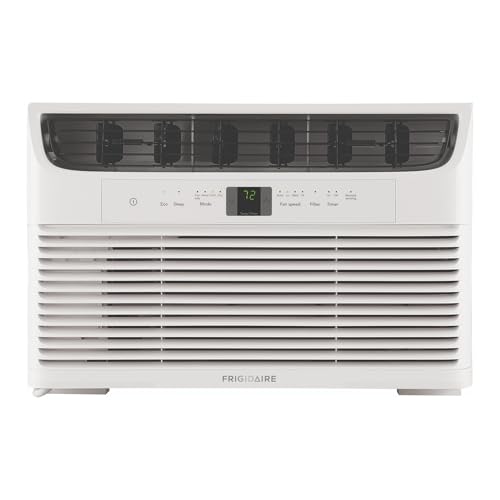
- Customizable Cooling: Achieve optimal comfort with custom temperature settings, 6-way directional airflow, and three different fan speeds
- Easy Maintenance: Effortlessly adjust settings with the remote control and keep your AC unit working efficiently with Clean Filter alerts that notify you when it's time to clean
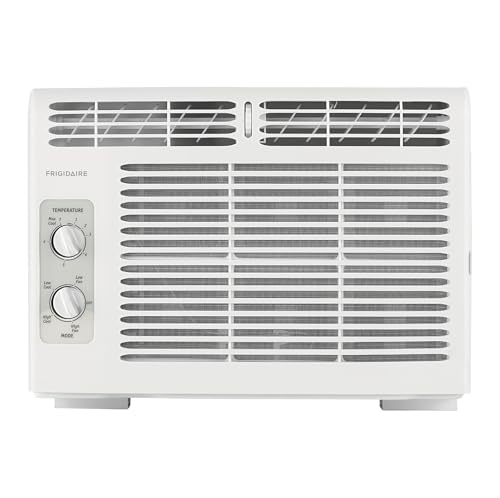
- Effortless Cooling: Achieve optimal comfort with customizable temperature settings and two fan speeds; Effortless Temperature Control helps to maintain your preset temperatures
- Easy Maintenance: Keep your air conditioner running efficiently with the easy-to-clean washable filter, designed to capture dust from the air for long-lasting performance
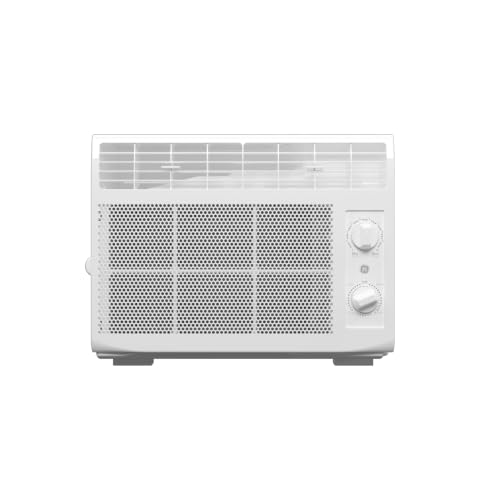
- BEST FOR SMALL ROOMS: Cools up to 150 sq ft efficiently with 5,000 BTU cooling power. Ideal for bedrooms, home offices, dorm rooms, workshops, and studio apartments. Compact 16.4"
- QUIET OPERATION - Quieter than many older window AC units, with 2 cooling modes (low 52 dBA for nighttime, high 56 dBA for rapid cooling) and 2 fan speeds for personalized
How to choose a window air conditioner
Match BTUs to the room, not to ambition. The single most common mistake is buying too big. An oversized AC cools the air fast, hits setpoint, and shuts off before it has pulled meaningful humidity out of the room — leaving you cold and clammy. Undersized is worse in a different way: it never shuts off and never gets comfortable. The units here cover 150, 250, 350 and 550 sq. ft. Measure your room and pick the rating that actually brackets it.
Decide whether noise is a dealbreaker. Every conventional unit here sits between 52 and 56 dBA. That's normal for window ACs and most people sleep through it. The Midea's 32 dBA low end is genuinely different — that's the argument for its price. The GarveeHome unit doesn't state a dBA figure at all, which is worth knowing before you put it beside your pillow.
Check your window dimensions before you order. This trips up more buyers than anything else. The GE needs a double-hung window 27.125"–36" wide with at least 13.375" of height. The Midea fits single- or double-hung windows 22"–36" wide with a 13.75" minimum height. Get the tape measure out first.
Weigh controls honestly. A remote is worth having if the unit ends up high in a window or behind furniture. Timers matter if you want the room cool before you walk in. But if you're buying for someone who'd rather turn a dial, the GE's mechanical controls are a feature, not a downgrade.
Efficiency pays back over time, not immediately. The Midea's ENERGY STAR certification and claimed 37%+ savings are real advantages, but they're spread across seasons. If you run an AC eight weeks a year in a spare room, a $159 unit is the smarter money.
FAQ
How many BTUs do I need for a 300 sq. ft. room? Look at the manufacturer's rated coverage rather than doing your own math. In this lineup, the Frigidaire 8,000 BTU model is rated up to 350 sq. ft., which brackets a 300 sq. ft. room comfortably. The 6,000 BTU units top out at 250 sq. ft.
Is a 10,000 or 12,000 BTU unit overkill for a bedroom? For a typical bedroom, yes. The Midea 12,000 BTU is rated for up to 550 sq. ft. — that's a large open living area or a studio, not a standard bedroom. In a small room, that much capacity short-cycles and dehumidifies poorly. Size down.
Which brand of window AC should I buy? Frigidaire, GE and Midea are all long-established names, and this list is mostly Frigidaire for a reason — the feature set at each price point is consistent and the specs are clearly published. GarveeHome is less established and doesn't publish a noise rating; if you're considering it for the low price, read the current Amazon reviews yourself before committing.
Do I need to drain a window air conditioner? The GE 5,000 BTU unit states no manual draining is needed under normal conditions. The Frigidaire units include Dry Mode, which removes excess moisture from the air. Beyond that, drainage behavior varies by model and installation tilt — check the manual for the unit you buy.
Can I install one of these myself? These are all designed for DIY installation. The GE includes an EZ Mount kit with foam insulation, the Frigidaire 5,000 BTU has adjustable side panels that extend to fit your window, and the Midea uses a quick-snap bracket you install first before setting the AC on top. Heavier units are much easier with a second person.
Related guides
- Hunter Original Ceiling Fan Review: Is It Worth $749?
- How to Succeed with Best home cooling, heating and fans - ceiling fans, tower fans, space heaters, misting fans, portable air conditioners, window air conditioners
- Best Camping Fans, Heaters & Portable AC for 2026 Trips
Key Takeaways
- Choosing the right best window air conditioners means matching the key features to your specific needs and budget
- Read real customer reviews and check the return policy before you commit
- Compare value across models — the priciest option is not always the best fit