As an Amazon Associate this site earns from qualifying purchases.
Comparison table
| Product | Price | Type | Cooling capacity | Room coverage | Noise | Dehumidification | Control |
|---|---|---|---|---|---|---|---|
| GrowthWing 14,000 BTU Smart WiFi | See the product list on this page | Compressor AC (window kit) | 14,000 BTU ASHRAE | Up to 700 sq. ft. | 42 dB in sleep mode | Dehumidifier mode, drain hose included | WiFi app, voice, remote |
| Garvee 8000 BTU (5000 SACC) | Check price on Amazon | Compressor AC (window kit) | 8,000 BTU ASHRAE / 5,000 SACC | Up to 350 sq. ft. | Not stated | Up to 45 pints/day | LED panel, remote |
| Garvee 8,000 BTU with Sleep Mode | Check price on Amazon | Compressor AC (window kit) | 8,000 BTU ASHRAE | Up to 350 sq. ft. | Under 50 dB | Dehumidifier mode | Remote |
| Feelfunn 8,000 BTU | Check price on Amazon | Compressor AC (window kit) | 8,000 BTU ASHRAE / 5,000 SACC | Up to 350 sq. ft. | Under 48 dB | Up to 45 pints/day | LED display, remote |
| AEROZY Windowless 24.5" | See the product list on this page | Evaporative cooler | Not stated | Not stated | Not stated | Humidifies (adds moisture) | Remote |
| cedeil with 1000ml Tank | See the product list on this page | Personal evaporative cooler | Not stated (8–15°F drop claimed) | Personal / desk | Not stated | Humidifies (adds moisture) | Remote |
Quick answer: If you want one unit that can actually cool a whole living room, the GrowthWing 14,000 BTU Smart WiFi Portable Air Conditioner is the only genuinely large-room option here. For a standard bedroom on a budget, either Garvee 8,000 BTU unit does the job for $159.99, and the Feelfunn 8,000 BTU Portable Air Conditioner adds a published efficiency rating if you care about running cost. If your window can't take a hose at all, you're looking at evaporative coolers instead — a different machine with different physics.
One thing to get straight before you spend money: a real portable AC needs a window. It works by pulling heat out of the room and blowing it outside through an exhaust hose. Anything advertised as "windowless" is an evaporative cooler or a mister — it adds moisture to the air and cools the spot right in front of it, but it cannot lower the temperature of a sealed room. Both types are on this list, clearly labeled, because both are legitimately useful. Just don't buy one expecting the other.
The second thing: BTU numbers are quoted two ways. ASHRAE is the older, bigger-sounding figure. SACC is the newer DOE standard that accounts for real-world losses through the hose. An 8,000 BTU ASHRAE unit is 5,000 BTU SACC — same machine, honest math. When you compare across brands, make sure you're comparing the same number.
Finding the right best portable air conditioners comes down to matching the features to how you will actually use it.
GrowthWing 14,000 BTU Smart WiFi Portable AC — Best Overall
The GrowthWing 14,000 BTU Smart WiFi Portable Air Conditioner is the highest-BTU unit here and the only one rated for large spaces — 14,000 BTU ASHRAE, covering up to 700 sq. ft. That's roughly double the coverage of the 8,000 BTU units, which matters if you're trying to cool an open-plan living area rather than a single closed bedroom.
It's also the most feature-complete. WiFi app control, voice commands, and a physical remote mean you can start it cooling before you get home. The 72-hour auto-evaporation system handles condensate without you emptying a tank, and there's an included drain hose for extended dehumidifier use when the humidity is high enough to outpace evaporation. Sleep mode runs as low as 42 dB with an auto-dimming display — the quietest stated figure on this list.
The window kit fits horizontal and vertical sliding windows from 20.39" to 67", which is a wide range, and the unit uses R32 refrigerant. At $399.99 it's more than twice the price of the Garvee units, and it should be — you're buying roughly double the cooling capacity plus smart control. Check current listings and recent buyer reviews yourself before ordering, since large units are the ones most likely to have shipping damage complaints.
Garvee 3-in-1 Portable Air Conditioner, 8000 BTU (5000 BTU SACC) — Best for Bedrooms
The Garvee 3-in-1 Portable Air Conditioner, 8000 BTU (5000 BTU SACC) AC Unit is refreshingly honest in its own product name — it states both the ASHRAE and SACC figures up front, which is more than most listings do. It covers rooms up to 350 sq. ft., cools from 61°F to 88°F, and pulls up to 45 pints of moisture per day in dehumidifier mode.
What sets this one apart from its near-twin sibling is the auto-swing louvers, which distribute air across the room rather than blasting one direction. There's a 24-hour timer, sleep mode, a full-function remote, and an LED panel. It uses R32 refrigerant, which Garvee cites for lower energy consumption and reduced environmental impact.
Setup is the usual portable-AC routine: adjustable window panel, extendable exhaust hose, no drilling. Garvee says most people finish in around ten minutes. The 360° swivel casters and recessed handles mean you can roll it between rooms, and the slim profile stores in a closet over winter — genuinely relevant if you're in an apartment or a rental where a window AC isn't allowed. At $159.99 this is the value pick.
Garvee 3-in-1 Portable Air Conditioner, 8,000 BTU with Sleep Mode — Best for Light Sleepers
The Garvee 3-in-1 Portable Air Conditioner, 8,000 BTU Portable AC Unit with Cooling, Dehumidifier & Fan for Rooms up to 350 sq.ft with Remote Control, Sleep Mode, 24H Timer & Window Kit is the same price and same 350 sq. ft. rating as the unit above, but it publishes a noise figure: under 50 dB. If you're sensitive to noise at night, a stated number beats no number.
The rest is familiar — cool, dehumidify and fan modes, a 61°F–88°F range, two fan speeds, a 1–24 hour programmable timer. It's self-evaporating, which Garvee says reduces how often you manually drain it, and the washable filter slides out for cleaning. That filter matters more than people expect: a clogged filter is the single most common reason a portable AC "stops cooling well" after a season.
The window kit fits openings from 15.47" to 47.24", with trimming possibly needed for small windows — worth measuring before you order. If your window is wider than 47", look at the GrowthWing's range instead. Otherwise, pick between the two Garvees on the feature you care about: auto-swing louvers on the other one, a published dB rating on this one.
Feelfunn 8,000 BTU Portable Air Conditioner — Best for Efficiency-Minded Buyers
The Feelfunn 8,000 BTU Portable Air Conditioners is the only unit here that publishes a CEER rating — 6.1. CEER is the combined energy efficiency ratio, and it's the spec that actually predicts your electricity bill. If two units cool the same room, the higher CEER costs less to run. Having the number at all puts Feelfunn ahead on transparency.
Capacity matches the Garvees: 8,000 BTU ASHRAE, 5,000 BTU SACC, 350 sq. ft., up to 45 pints of moisture removed per day. The temperature range is 60°F–86°F, a touch cooler at the bottom end than the Garvees' 61°F. It runs under 48 dB, and sleep mode auto-adjusts the temperature to save energy overnight.
Feelfunn is also the only listing here that gives full dimensions and weight: 12 x 11.4 x 26.7 inches, 41.5 lbs. That's genuinely useful — you can check whether it fits beside your desk, and 41.5 lbs is heavy enough that you'll want those 360° casters for anything more than sliding it a few feet. There's a full-water alert to prevent spills, plus an LED display and remote. At $199.98 it's $40 more than the Garvees for a comparable cooling spec; the CEER number and the published dimensions are what you're paying for.
24.5" Small Evaporative Air Cooler for Room No Window — Best for Rooms With No Usable Window
The AEROZY Windowless Portable Air Conditioner, 24.5" Small Evaporative Air Cooler is an evaporative cooler, not a compressor AC — the listing says so plainly, which is more honest than most of this category. It cools by evaporating water, so it will lower the temperature of the air moving past it and raise the humidity of the room. In a dry climate that's a real effect. In a humid one, it's mostly a fan.
Where it earns its place: no window, no hose, no exhaust. If you're in a basement, an interior office, a dorm with sealed windows, or anywhere a hose simply isn't possible, this is the option that physically works. It's a bladeless design, which AEROZY notes is safe around kids and pets, and it has a 2-gallon water tank to minimize refills.
You get four modes (Cool, Natural, Sleep, ECO), three fan speeds, 120° oscillation for wide coverage, and a remote. The timer is listed two ways in AEROZY's own copy — 7 hours in the title, 15 hours in the feature bullets — so confirm the actual figure on the current listing before you rely on it. Four ice packs are included; freezing them and dropping them in the tank is what gets you the coldest output. At $119.99 it's mid-priced here, and it's the only unit on the list that solves the no-window problem at any real scale.
cedeil Portable Air Conditioner with 1000ml Water Tank — Best for Desk and Personal Cooling
At $39.99, the cedeil Portable Air Conditioners with Upgraded Cooling Fan and 1000ml Water Tank is the cheapest thing here by a wide margin, and it's a personal cooler — fan, humidifier and evaporative cooler in one small USB-powered unit. It is not going to cool a room, and cedeil doesn't claim it will. It cools the space directly in front of it.
For that job it's well specified. Four fan speeds up to 4.2 m/s, two mist settings, and 70° adjustable louvers to aim the airflow. cedeil states that high mist with cold water or ice lowers ambient temperature by 8–15°F — read that as the air at the outlet, not the room. The 1000 ml tank supports 6–8 hours of continuous use with a wide-mouth opening for refilling, and there's a 2/4/6-hour shutoff timer.
USB power is the quiet superpower here: it runs off a laptop, power bank, car charger or wall adapter, so it works at a desk, in a car, or on a camping trip. There's an RGB night light and a remote. Buy it as a supplement to a real AC or as a targeted fix for one hot desk — not as your only cooling.
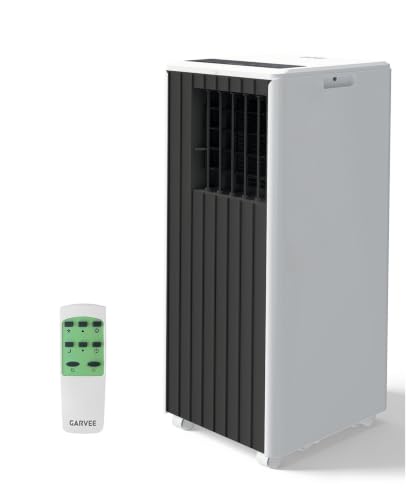
- Fast & Efficient Spot Cooling for Rooms Up to 350 Sq. Ft: Designed with 8,000 BTU (ASHRAE) cooling power, this unit effectively removes heat from spaces like bedrooms, living
- 3-in-1 Climate Control: Cooling, Dehumidifier & Fan: This portable AC offers adjustable cooling (61°F–88°F), dehumidification (removes up to 45 pints/day), and a 2-speed fan. The
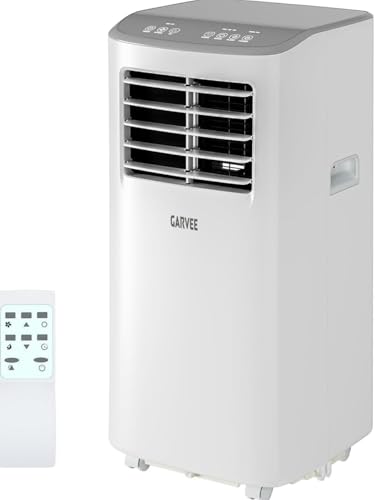
- 3-in-1 Functionality: Cool, dehumidifier, and fan mode for year-round comfort. In summer, keep your space refreshingly cool (61°F-88°F). On milder days, switch to fan or
- Sleep-Friendly Design: Sleep mode and 1-24 hour programmable timer ensure customized comfort. Quiet operation (<50dB) won't disturb your rest while maintaining a pleasant room
How to choose
Start with the window question. If you have a window that opens and a place to route a 5–6 inch hose, buy a compressor unit — it's the only kind that removes heat from a room. If you genuinely can't vent, your realistic options are the AEROZY or the cedeil, and you should adjust expectations accordingly. In humid climates, evaporative coolers underperform badly.
Then measure the window opening. This trips up more buyers than anything else. The Garvee 8,000 BTU with Sleep Mode fits 15.47" to 47.24" openings; the GrowthWing fits 20.39" to 67". A tall, narrow casement window may not work with any of them without a custom panel. Measure before you order, not after.
Match BTU to room size honestly. The three 8,000 BTU units all state 350 sq. ft. The GrowthWing states 700 sq. ft. If your room sits between those, buy up rather than down — an undersized unit runs constantly, never hits setpoint, and costs more in electricity than the bigger unit that cycles off.
Noise is a real spec, not a vibe. The GrowthWing's 42 dB sleep mode, Feelfunn's under-48 dB and Garvee's under-50 dB are meaningfully different. A few decibels is a large perceptual gap at night. If a listing doesn't state a number, assume it's not a selling point.
Check the drainage design. The GrowthWing claims up to 72 hours drainage-free with auto-evaporation; the Garvee 8,000 BTU with Sleep Mode is self-evaporating; the Feelfunn has a full-water alert. In a humid room, no self-evaporating unit is truly maintenance-free — you'll still empty it sometimes, or run a drain hose to a floor drain.
Look at efficiency if you'll run it daily. Feelfunn is alone here in publishing a CEER (6.1). The Garvee units and the GrowthWing cite R32 refrigerant, which is more environmentally friendly and generally efficient, but that's a refrigerant choice rather than a measured efficiency number for the whole appliance.
Finally, go read the current reviews yourself. Specs tell you what a unit is designed to do; buyer reviews tell you about the window kit that didn't fit, the hose that kept popping off, the fan that got loud in month three. Read the recent one- and two-star reviews on the listing before you commit — that's where the useful information lives.
FAQ
What's the difference between ASHRAE and SACC BTU ratings? ASHRAE is the older test standard and produces a larger number; SACC is the DOE's newer standard that accounts for real-world losses like heat leaking back in through the exhaust hose. The Garvee 8000 BTU unit and the Feelfunn both state 8,000 BTU ASHRAE and 5,000 BTU SACC — the same machine described two ways. Compare SACC to SACC when you can, and never assume an 8,000 BTU portable equals an 8,000 BTU window unit.
Can a portable air conditioner really work without a window? Not a compressor one. Any air conditioner produces heat as a byproduct of cooling, and that heat has to leave the room through an exhaust hose. Units marketed as "windowless," like the AEROZY Windowless Portable Air Conditioner, are evaporative coolers — they cool by evaporating water into the air, which works in dry climates and produces a noticeable local breeze, but won't drop the temperature of a closed humid room.
What size portable AC do I need for a 400 sq. ft. room? None of the 8,000 BTU units here are rated past 350 sq. ft., so for a 400 sq. ft. space the GrowthWing 14,000 BTU unit, rated to 700 sq. ft., is the safer choice on this list. Sizing up also helps if the room gets direct afternoon sun, has high ceilings, or contains heat-generating equipment — all of which effectively make a room "bigger" from a cooling standpoint.
How loud are portable air conditioners at night? The quietest stated figure here is the GrowthWing at 42 dB in sleep mode, followed by the Feelfunn at under 48 dB and the Garvee 8,000 BTU with Sleep Mode at under 50 dB. Roughly speaking, 40 dB is a quiet library and 50 dB is a running refrigerator. Every compressor unit here has a sleep mode that reduces fan speed and gradually adjusts temperature overnight, which helps as much as the raw number does.
Related guides
- DREO Tower Fan Review: Which Model Fits Your Room
- Get a Best home cooling, heating and fans - ceiling fans, tower fans, space heaters, misting fans, portable air conditioners, window air conditioners Quote
- Best home cooling, heating and fans - ceiling fans, tower fans, space heaters, misting fans, portable air conditioners, window air conditioners with High Value Assets
Key Takeaways
- Choosing the right best portable air conditioners means matching the key features to your specific needs and budget
- Read real customer reviews and check the return policy before you commit
- Compare value across models — the priciest option is not always the best fit